

ERP Knowledge Assistant
A retrieval-augmented assistant that answers questions from ERP issue data
01. THE NEED
This organization uses an ERP solution that houses all knowledge regarding their projects, such as issues, their descriptions, and the history around them. The team wanted to be able to access this information by asking questions about the content in plain language and getting answers based on it, instead of searching records by hand.
We set out to build a retrieval-augmented generation (RAG) implementation that reads the ERP and answers questions about what is in it.
#AI
#RAG
#NLP
#LLM
02. THE SOFTWARE
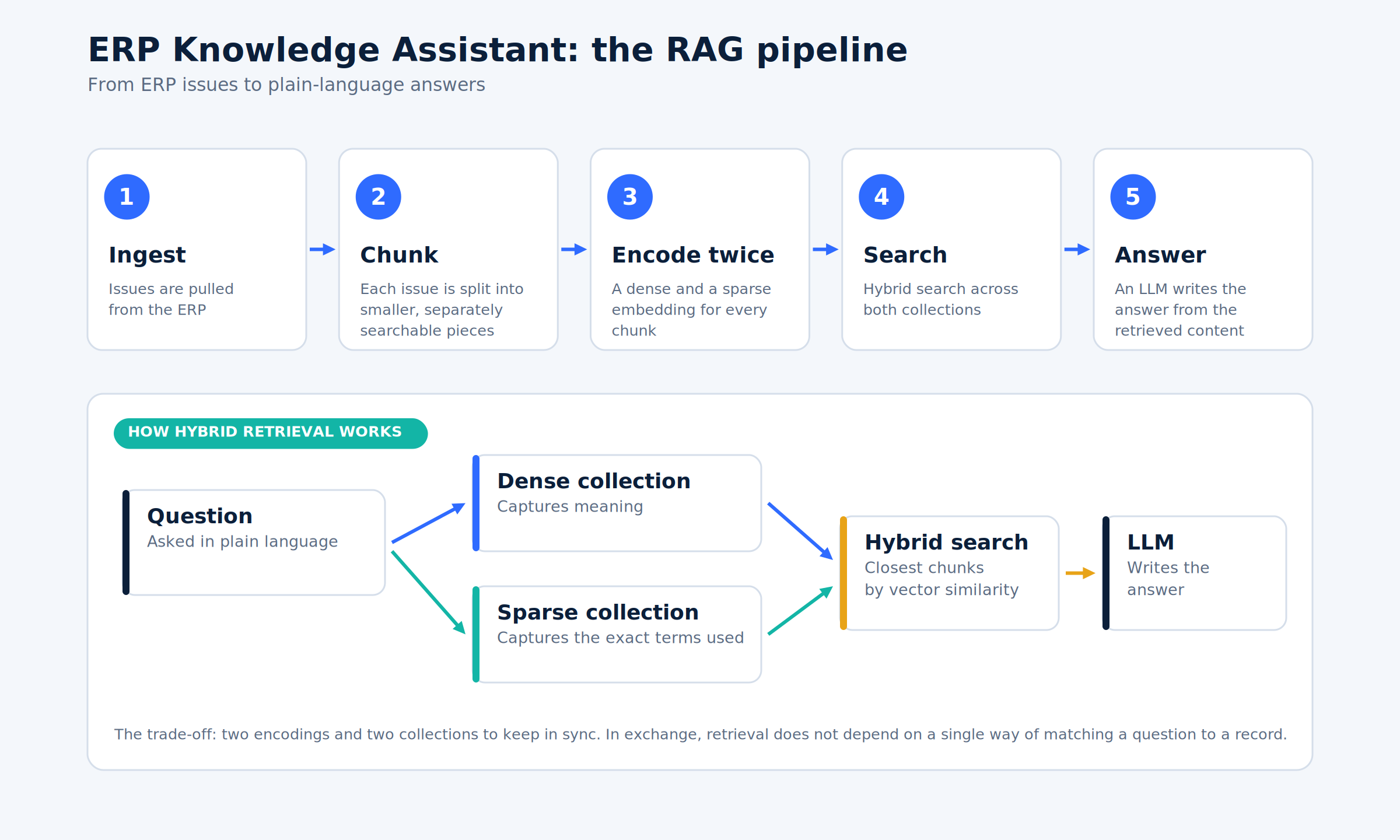
We built a chat application on top of a RAG pipeline. It takes the issues from the ERP, splits them into chunks, and stores two kinds of embeddings for each chunk in a vector database. When someone asks a question, the system finds the closest chunks and sends them to an LLM, which writes the answer from that content.
The pipeline has five steps:
- Ingest. Issues are pulled from the ERP.
- Chunk. Each issue is split into smaller pieces that can be searched on their own.
- Encode twice. Every chunk gets a dense embedding, which captures meaning, and a sparse embedding, which captures the exact terms used. Each type lives in its own collection.
- Search. A hybrid search runs across both collections and returns the chunks closest to the question, based on vector similarity.
- Answer. The retrieved content goes to an LLM, which generates the response.
The trade-off is two encodings and two collections to keep in sync. In exchange, retrieval does not depend on a single way of matching a question to a record.
03. SOLVED PROBLEMS
Critical information is now faster to find. You ask a question in plain language and get an answer built from the relevant ERP issues. That means less overhead, and less stress when an answer is urgent.
The answers are also stronger because they rely on the organization’s own ERP, which holds extensive knowledge of the industry, and not on the general knowledge of an LLM. They reflect past projects, terminology, and history.



04. KEY FEATURES
- Answers drawn from ERP issue content
- Hybrid search that combines dense and sparse embeddings
- Both embedding types stored in a vector database
- LLM-generated answers based on the retrieved content
- A simple chat interface for asking questions
05. TECHNOLOGIES

Python
Vector database
06. BEFORE AND AFTER
| Before | With the ERP Knowledge Assistant | |
|---|---|---|
| Finding information | Searching records by hand | Asking a question in plain language |
| Answer source | Whatever the person manages to find | Retrieved ERP content, written up by an LLM |
| Urgent questions | Slow and stressful | Fast answers from the relevant issues |
07. RESULTS
- Much faster answers — A plain-language question replaces manual searching through ERP records.
- Grounded in your own history — Answers reflect past projects, terminology and decisions recorded in the ERP, not the LLM’s general knowledge.
- Less stress when it’s urgent — The relevant issues surface quickly, with far less overhead.
08. WHAT’S NEXT
Next: extending the assistant to more ERP content, such as attachments, and evaluating answer quality in a more systematic way.
See also: ERP Cursor Sync, which connects developers’ AI-assisted work to the same ERP.
Have a project in mind?
Get in touch with us for your software development needs!